


Another Article About the Neck . . . or Is It?
While the neck is a bridge, a pathway, the position of the neck and head can also indicate a multitude of other things happening beneath the surface.
The fibularis longus is a muscle located along the full length of the lateral leg. It is contained within the lateral compartment along with the fibularis brevis muscle.
The muscle belly is relatively superficial and originates on the head and proximal portion of the lateral fibula. Moving distally, its tendon runs behind the lateral malleolus, extends from lateral to medial across the bottom of the foot, and inserts near the anterior tibialis on the medial side. Together, the fibularis longus and anterior tibialis muscles form a structure called the anatomical stirrup, describing the way the two muscles sling around the bottom of the foot. This structure helps support medial arch and control movement of the foot from side to side.
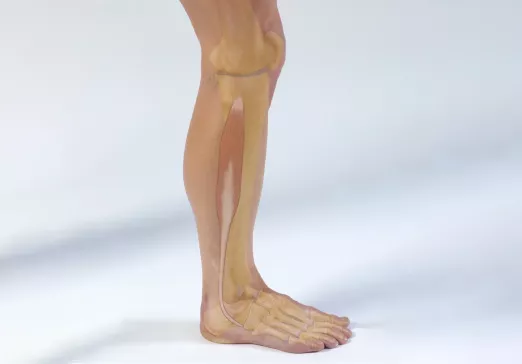
The location of the fibularis longus allows it to contribute to ankle plantar flexion, as well as strongly perform ankle eversion. The fibularis brevis is a synergist in both motions, where the fibularis tertius is synergistic in ankle eversion alone. The tertius is positioned more anteriorly, giving it leverage for ankle dorsiflexion rather than plantar flexion like the longus and brevis.
Ankle eversion helps position the foot before planting it on the ground during gait and is also used when moving the body from side to side. The fibularis longus, along with the other fibularis muscles, helps pull the center of gravity from medial to lateral over the planted foot. This side-stepping movement is common when walking over and around objects. Ankle eversion also helps initiate and control direction changes.
Activities that require pushing with the legs from side to side, like skiing and skating, rely on the fibularis muscles, along with the hip abductors, to power the movement. Weakness, poor mobility, or lack of control of the fibularis longus and other ankle muscles may contribute to injuries such as lateral ankle sprains or chronic conditions such as tendinitis, shin splints, or plantar fasciitis.
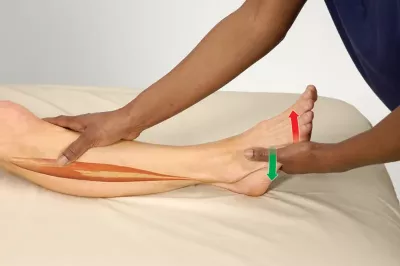
Image copyright 2010 Wolters Kluwer Health, Lippincott Williams & Wilkins.
Positioning: client supine or seated with the knees extended.
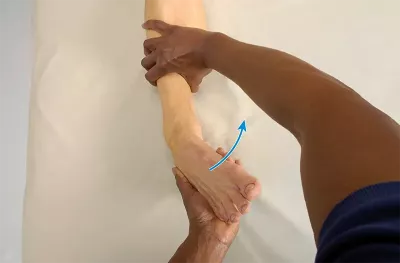
Image copyright 2010 Wolters Kluwer Health, Lippincott Williams & Wilkins.
Positioning: client supine or seated with the knees extended.
While the neck is a bridge, a pathway, the position of the neck and head can also indicate a multitude of other things happening beneath the surface.
Understanding fibroblasts and the extracellular matrix changes how we think about the tissue we touch.
Studies reveal that 37 percent of the force generated by muscle contraction is transmitted to adjacent connective tissue structures instead of the bones.
Ongoing research suggests the sciatic nerve's healthy functioning depends on its fascial connections.