


Superior Outcomes
A treatment plan is what elevates massage therapy from a service to a therapeutic profession. It is the tangible output of our clinical reasoning.
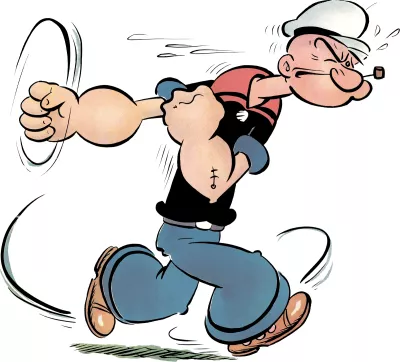
Whether from typing, gripping, texting, or doing bodywork, our forearms bear a hidden load. Overworked yet often undercared for, their deeper soft tissue structures—like the interosseous membrane or the long myofascial structures related to the wrist, hand, and fingers—can become overtoned, dense, restricted, and desensitized or achy. Popeye's exaggerated arm physique (Image 1) pokes fun at this: When overused, our forearms bulk up, tighten, and lose their suppleness.
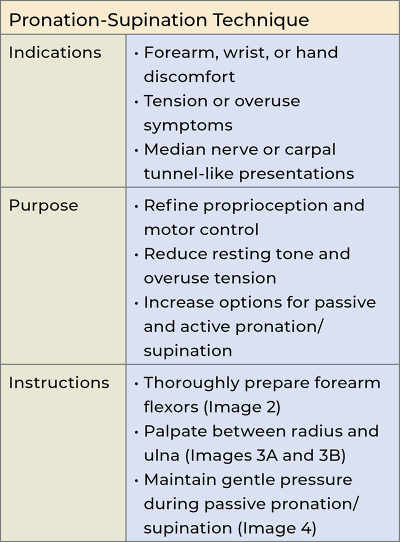
Fortunately, there are things we can do to help restore ease, dexterity, and comfort. The pronation-supination technique is a hands-on way to reduce tension, increase mobility, and fine-tune proprioception in this vital part of the body.
In pronation, the radius crosses over the ulna, a unique bony interplay that enables everyday actions like turning a doorknob, unbuttoning a button, or twisting a jar lid. But this crossing can become crowded or uncomfortable. Unnecessarily protective movement patterns, muscular overuse, lack of glide at fascial interfaces, or entrapment of neurovascular structures like the median nerve (for example, by the pronator teres) can lead to limitation, pain, weakness, or numbness.
The interosseous membrane that spans between the radius and ulna is richly innervated and contributes to load transfer, wrist stability, and proprioceptive feedback.1 When proprioceptive awareness of this membrane is stimulated via a therapist's skilled touch, it can enhance the brain's sensory and motor representations of the forearm and hand—potentially boosting both comfort and dexterity.
Begin with thorough preparatory work to relax and restore myofascial glide to the dense, often overused flexors of the forearm (Image 2).
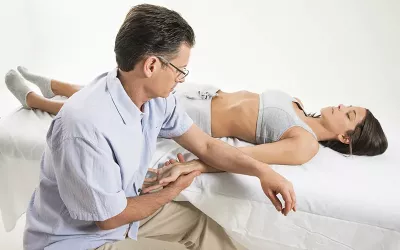
Then, using a thumb-to-finger grip, palpate between the radius and ulna, feeling for the interosseous space (Images 3A and 3B).
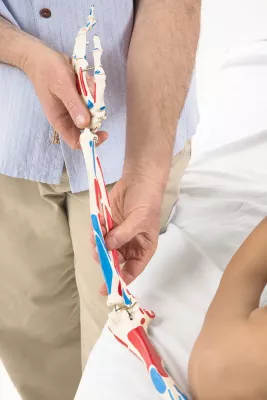
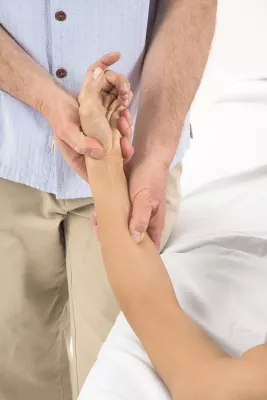
With sustained but relaxed pressure, gently guide the forearm through its full range of passive pronation and supination. Maintain the pressure between the bones throughout the motion (Image 4). Repeat this along as much of the interosseous space as you can palpate.
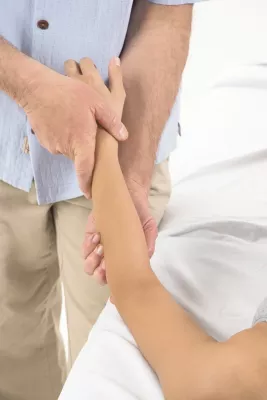
Imagine keeping the space open between the radius and ulna through the entire range of pronation and supination, even as the natural crossing in pronation tends to narrow it. The tactile paradox this creates in your client's brain helps deepen proprioceptive refinement while encouraging the release of unneeded tension and protection.
When performed with presence and patience, this technique is often deeply satisfying to the receiver. Clients report a sense of release, lightness, and easier movement. The forearms—so frequently neglected or bound up—seem to "breathe" again. These local effects often translate into a surprising sense of whole-body openness and ease.
This technique is particularly helpful for addressing forearm, wrist, hand, or finger issues related to tension, limited mobility, weakness, or carpal tunnel-like symptoms. It offers our clients the sensation of openness while moving, leading to greater options for movement and motor control while dialing down the hardworking forearms' overactivity, tension, and tone.
1. Carla Stecco et al., "Anatomy of the Deep Fascia of the Upper Limb. Second Part: Study of Innervation," Morphologie 91, no. 292 (March 2007): 38-43, https://doi.org/10.1016/j.morpho.2007.05.002.
A treatment plan is what elevates massage therapy from a service to a therapeutic profession. It is the tangible output of our clinical reasoning.
Context is powerful: Even light, mindful touch can significantly shift pain and proprioception, reminding us that how we work matters as much as what we do.
Deep gluteal syndrome can be triggered by multiple causes. Sorting through those causes can be tricky, but doing so will also help your clients.
Considering the situation that led to your client’s pain can prove as valuable as understanding where the pain exists.